

?
have questions?
Let the District know when something needs attention.
Click the button below to report issues online and track updates.

Emergency Preparedness
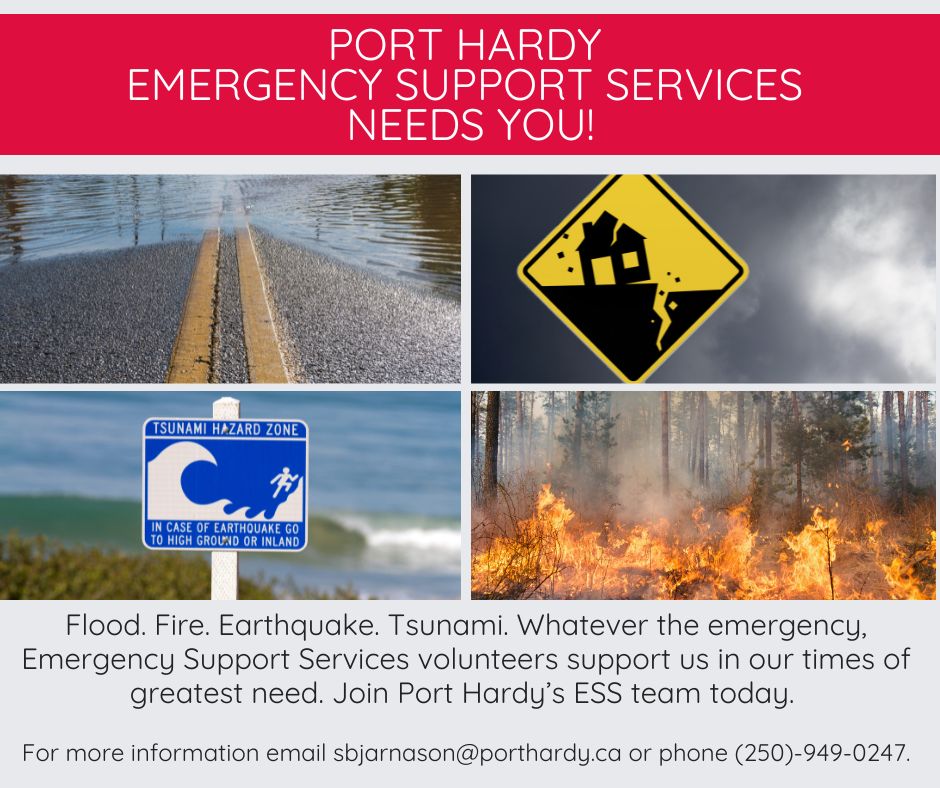
The District of Port Hardy works with the regional Emergency Preparedness Program (EP) to ensure that response efforts are coordinated quickly and efficiently in the case of an emergency. EP includes local Municipal representatives, as well as members from the RCMP, fire department and ambulance. Members are trained to respond to both local and regional disasters, as needed.
The information contained on this page is designed to help every resident to be aware of possible emergencies and disasters and how to plan to minimize their effects. You should be aware of the following potential scenarios which may occur in an emergency.
Evacuation Sites
Hardy Bay area residents should report to the Civic Centre at 7400 Columbia Street – Storey’s Beach and Beaver Harbour residents should report to the Avalon School at 4640 Byng Road.
IN THE EVENT OF AN EMERGENCY STAY OFF YOUR TELEPHONES AND CELLULAR PHONES. THESE SYSTEMS NEED TO BE AVAILABLE FOR EMERGENCY SERVICES
72 Hours, Are you Prepared?
After a disaster (fire, tsunami, earthquake, toxic spill, etc.) you may have to look after yourself for 72 hours or more until services or supplies are restored. You may have to temporarily leave your home and go to a reception center for help with food, clothing or lodging. Family members may get separated. Your family should have one out-of-town contact person who is designated to receive and relay messages for your family. Ensure your children are aware of the contact person and their phone numbers. You should also know how to help emergency response personnel find you house.
Ask yourself these questions:
- Is your house number clearly visible from the street?
- Can it be seen at night?
For more emergency resources, visit the following links:
In the event of an emergency, the following sites have up-to-date information:

Emergency Program Coordinator
Lionel Gunson


3,239

Port Hardy Emergency
Port Hardy Emergency is your District of Port Hardy Emergency Management Team. We will be working during any local emergencies to ensure the safety of our residents and a speedy recovery for the community.

Valentine's Day is about more than chocolate... though we do love chocolate. 😉Why not spread a little love with a fully equipped emergency kit? 💕![]()
![]() Not quite sure what to include in your PreparedBCredBC's tips are a great starting point to keep you and your loved ones emergency ready with the basics.
Not quite sure what to include in your PreparedBCredBC's tips are a great starting point to keep you and your loved ones emergency ready with the basics.![]()
![]() ✅ Non-perishable food
✅ Non-perishable food![]() ✅ Water
✅ Water![]() ✅ A battery-powered flashlight and radio
✅ A battery-powered flashlight and radio![]() ✅ Extra batteries
✅ Extra batteries![]() ✅ A first-aid kit and medications
✅ A first-aid kit and medications![]() ✅ Copy of your emergency plan and copies of important documents
✅ Copy of your emergency plan and copies of important documents![]() ✅ Garbage bags and moist towelettes
✅ Garbage bags and moist towelettes![]() ✅ Seasonal clothing, sturdy footwear and an emergency blanket
✅ Seasonal clothing, sturdy footwear and an emergency blanket![]()
![]() Don't forget to customize your kit with important specialty items like pet food and prescriptions!
Don't forget to customize your kit with important specialty items like pet food and prescriptions!![]()
![]() www2.gov.bc.ca/gov/content/safety/emergency-management/preparedbc/build-an-emergency-kit-and-grab...
www2.gov.bc.ca/gov/content/safety/emergency-management/preparedbc/build-an-emergency-kit-and-grab...
We all know there are few things that pair better than PB&J.🥜🍇🥪![]()
![]() However, there is no denying water and non-perishables are a match made in heaven when it comes to emergency preparedness.
However, there is no denying water and non-perishables are a match made in heaven when it comes to emergency preparedness. ![]()
![]() Why wait until Valentine's Day to stock your emergency kit with a supply of water and dry goods? Spread the love where it counts, emergency preparedness #forthewin!💕
Why wait until Valentine's Day to stock your emergency kit with a supply of water and dry goods? Spread the love where it counts, emergency preparedness #forthewin!💕![]()
![]() www.facebook.com/share/p/1GPKiZ29CS/
www.facebook.com/share/p/1GPKiZ29CS/
This content isn't available right now
When this happens, it's usually because the owner only shared it with a small group of people, changed who can see it or it's been deleted.
Is there really anything more romantic than being emergency prepared? We don't think so!💕![]()
![]() Don't wait until Valentine's Day to spark the romance by stocking up your emergency kit and checking that your flashlight and batteries are ready to go!
Don't wait until Valentine's Day to spark the romance by stocking up your emergency kit and checking that your flashlight and batteries are ready to go!
This content isn't available right now
When this happens, it's usually because the owner only shared it with a small group of people, changed who can see it or it's been deleted.
Last weekend's unexpected power outage is a prime example of the importance of being prepared. While service was restored after only a couple hours, extended outages do occur. You could be left without light, heat, air conditioning, and hot water for multiple days. Get power outage ready now with a plan and supplies, before the lights go out! ✅️⚡️
This content isn't available right now
When this happens, it's usually because the owner only shared it with a small group of people, changed who can see it or it's been deleted.
This exciting opportunity closes tomorrow! Learn more 👉 FireSmart Coordinator - Port Hardy share.google/RcKoyPSGobKt8gct2
This content isn't available right now
When this happens, it's usually because the owner only shared it with a small group of people, changed who can see it or it's been deleted.EMERGENCY PREPAREDNESS WEEK, May 3-9, 2026
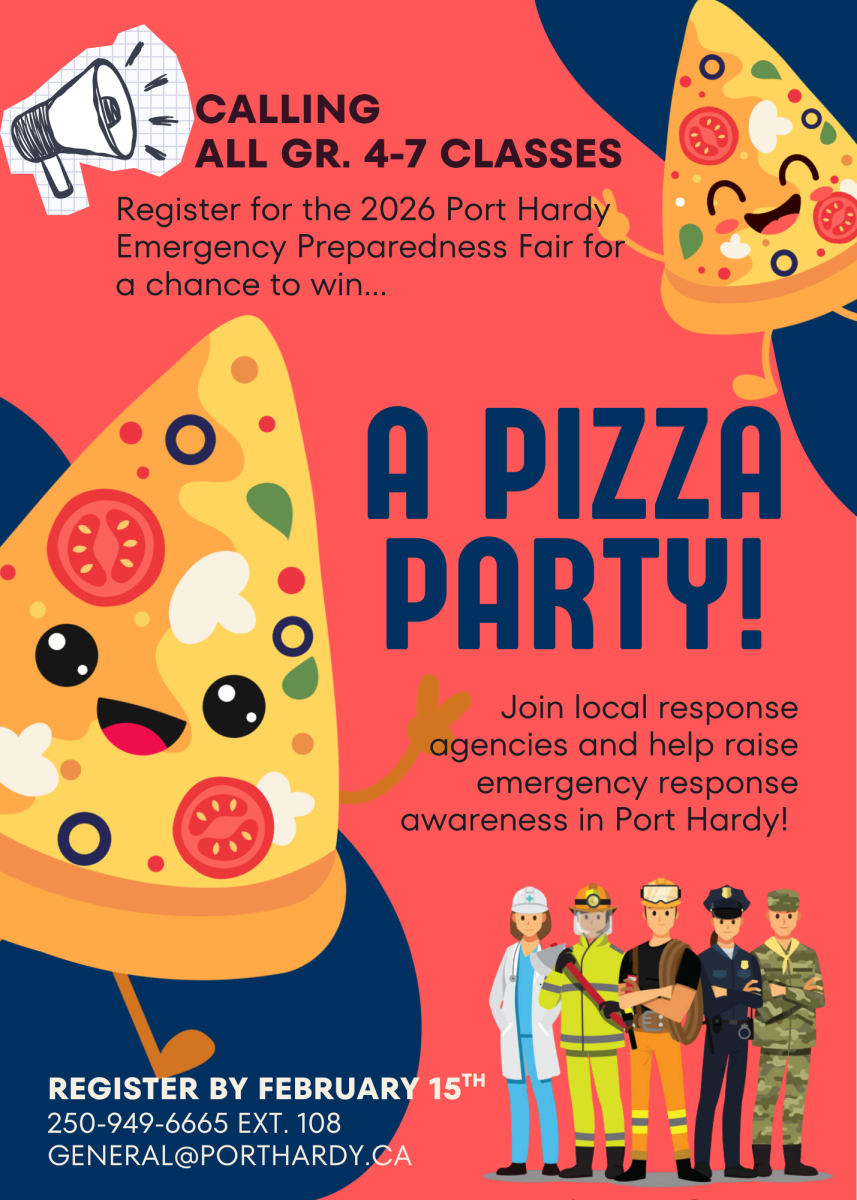
An emergency can happen at any time. Emergency Preparedness Week is observed annually the first full week of May. This nationally recognized week aims to raise awareness on the importance of being ready emergency ready. Understanding the local hazards and knowing how to protect yourself and your household can improve your readiness and response when it matters most. To help, Port Hardy Emergency celebrates with an annual kick-off event. This year, Port Hardy Emergency invites Port Hardy and area Gr. 4-7 students to partake in an Emergency Preparedness Fair! Learn more about the 2026 Emergency Preparedness Fair.
Register your class by February 15th for a chance to win a class Pizza Party!
TSUNAMI PREPAREDNESS WEEK, April 12-18, 2026
Observed annually during the second full week of April, coastal communities across British Columbia take part in Tsunami Preparedness Week. Tsunamis have occurred throughout history along the British Columbia Coast. Large, fast moving tsunamis could happen at any time as a result of an event like an earthquake that may occur close by or even far away. Being tsunami ready can help protect and prepare yourself and loved ones should the time come.
Tsunami Notification Zones:
BC’s coastline is divided into 5 discrete Tsunami Notification Zones, Port Hardy is located in Tsunami Notification Zone B.
Levels of Tsunami Alerts:
There are 5 levels of tsunami alerts. Each alert type has a corresponding level of threat and action.
| ALERT | THREAT | ACTION |
| Warning | Flood wave possible | Evacuation suggested |
| Advisory | Strong currents likely | Stay away from the shore |
| Watch | Danger level not yet known | Stay alert for more information |
| Information Statement | Minor waves at most | No action suggested |
| Cancellation | Tidal gauges show no activity | Confirm safety of local areas |
Stay Informed:
If a Tsunami Warning is issued, the warning will be broadcast across television, radio and compatible mobile devices through B.C.’s emergency alert system. Local emergency information will also be shared through the Port Hardy Mass Notification System.
If you are near the coast when an earthquake occurs, don’t wait, take action!
-
- Immediately drop, cover, hold.
- Once the shaking stops, move to high ground following your designated tsunami evacuation route.
- Follow all instructions from local officials.
- Stay on higher ground until you receive the “all clear” message from your local authority, tsunami waves can last several hours.
Never go to the beach to watch the waves, a tsunami can move faster than you can run.
Tsunami Hazard Zones in Port Hardy:
Low-lying areas such as beaches, estuaries, and marinas are especially vulnerable to tsunamis. While signs indicating a tsunami hazard zone are posted throughout the community, it is important to be aware of where these zones occur and whether you are in one. In the event that a Tsunami Warning has been issued CHECK BEFORE heading to the nearest evacuation site, not everyone may need to evacuate as some areas are outside the hazard zone.
For more information on tsunami preparedness, check out the following resources:
Earthquake Preparedness
Earthquakes can’t be predicted. When you feel the ground shake, immediately Drop, Cover and Hold on. Your response may be different depending on where you are and what you are doing. Visit PreparedBC to learn more about how to respond during an earthquake in different scenarios, and what to do when the shaking stops.

For more information and resources on earthquake preparedness visit PreparedBC online
Wildfire Preparedness
Wildfire is a risk to many areas across the province, including Port Hardy and area. While some regions are more vulnerable, seasonal weather changes can increase local risk. Don’t wait to get prepared. Learn more about what to do before, during and after a wildfire.
For more information on wildfire preparedness check out the PreparedBC Wildfire Preparedness Guide
Get FireSmart!
We all play a critical role in mitigating wildfire risks. Simple actions around your home and property can decrease the intensity of a wildfire, slow its spread, and help stop buildings and other structures from being damaged in a fire.
To help residents and businesses in planning for an emergency event of any kind, Port Hardy Emergency has prepared a handout with some quick tips and ideas on how to be emergency prepared for hazards of any kind.
Emergency preparedness involves 3 basic steps:
-
- Know the Risks
- Make a Plan
- Have a Kit
ADOPT THE “ICE ADVICE” (ICE: In Case of Emergency)
Use your cell phone as an emergency lifeline. At the touch of a button, it can be used to call 911, the police, or to reunite loved ones separated during a disaster.
-
- Add an entry in the contacts list in your cell phone under the label ICE with the names and phone numbers of people who should be called in case of an accident or injury.
- Simply put the acronym ICE before the names you want to designate as key contacts or next of kin, creating entries such as ICE1, ICE2 and ICE3, etc.
- This will allow responders at the scene to know right away who to notify.
Use Of ‘HELP’ And ‘OK’ Signs
The following signs can be printed and kept in your emergency preparedness kit. They can be displayed in a home, business or vehicle window to show emergency responders and others that you are in need of assistance (HELP) or alternatively, are not in need of assistance (OK): Click here to download help/ok signs.